
U.S. Midterm Drivers
Ten forces that could reshape the election before voters cast their ballots

I do not usually write about politics, and I do not want this to become a partisan post. There are already plenty of those. My purpose is different: to offer a simple framework for thinking critically about the U.S. midterm elections this fall.
The midterms will not be shaped by one event, one poll, or one speech. They will be shaped by several interacting forces: public opinion, economic pressure, candidate quality, campaign money, issue attention, turnout, information disorder, election rules, foreign-policy shocks, and state-level races.
In this post, I lay out what I see as the ten most important drivers that could change current expectations. The goal is not to predict the result today. The goal is to help us read the news more clearly as events unfold.
In the next posts, I will look at the main stakeholders: the White House, both national parties, candidates, donors, media platforms, advocacy groups, courts, state officials, and voters themselves. I will also discuss the strategies these groups may use to influence the election.
One new factor deserves special attention: AI. Artificial intelligence is now available to campaigns, activists, media actors, foreign actors, and ordinary citizens. It can help organize, target, persuade, confuse, fabricate, and amplify. That does not mean AI will decide the election. It does mean AI will be part of the election system.

I hope this framework invites a healthy discussion. These issues will shape not only the U.S. midterms, but also the way other democracies handle campaigns, information, trust, and legitimacy in the years ahead.
Ten Drivers to Watch
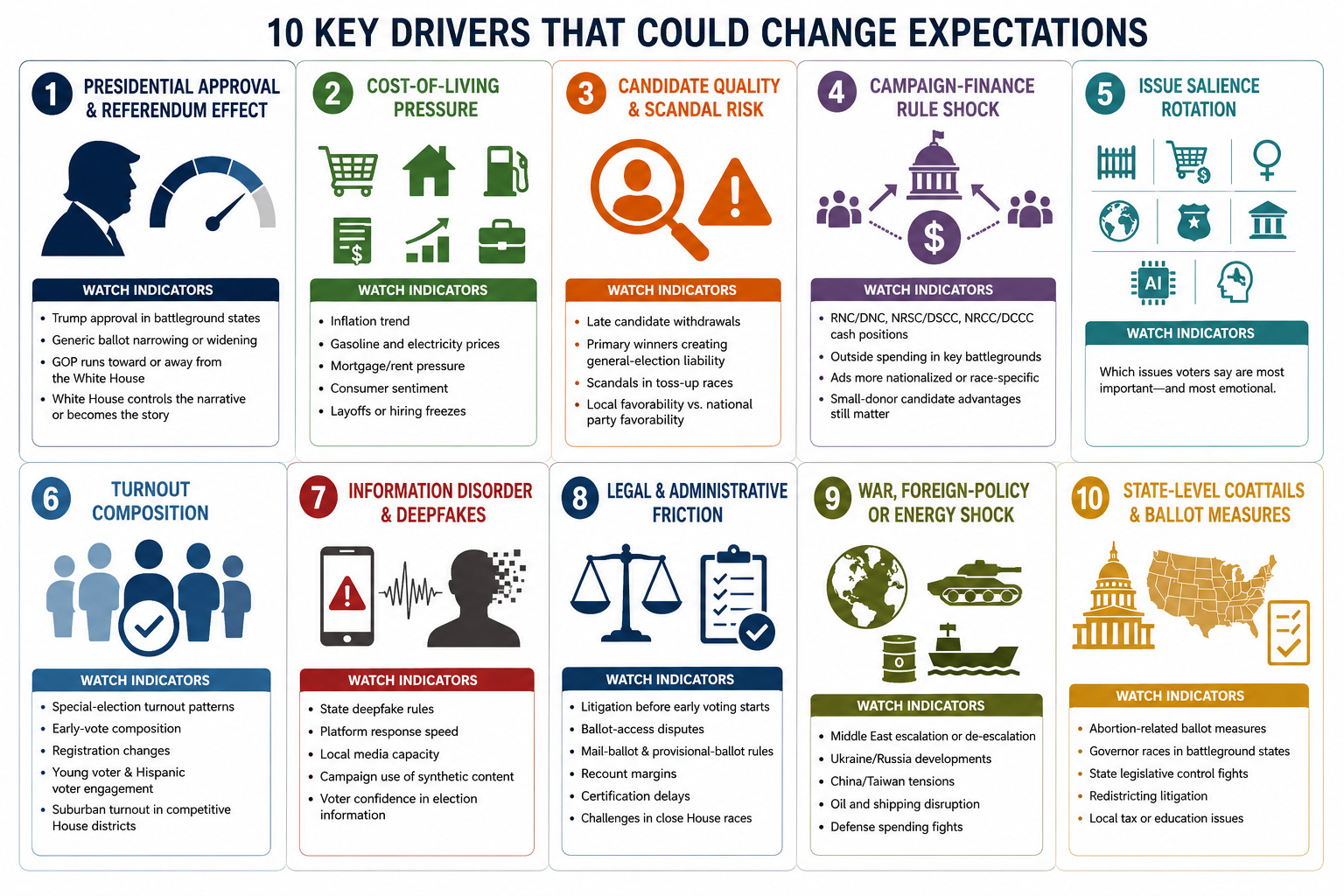
1. Presidential approval and the referendum effect.
Midterm elections often become a referendum on the party that controls Washington. The key question is whether the election remains a judgment on President Trump and Republican control, or whether Republicans can shift attention elsewhere. If Trump’s approval weakens in battleground states, Republican candidates in marginal districts face more national drag. If approval recovers, Democrats lose some of the clarity of the referendum frame. Watch Trump approval, the generic congressional ballot, and whether GOP candidates run toward or away from the White House. (Emerson College Polling)
2. Cost-of-living pressure.
The economy matters to voters less as an abstraction than as daily pressure: groceries, rent, insurance, gasoline, electricity, interest rates, debt, and job security. If voters feel squeezed, the election can nationalize against the governing party. If voters believe conditions are improving, the issue loses force. Watch inflation, gasoline and electricity prices, mortgage and rent pressure, consumer sentiment, layoffs, and hiring freezes. (Federal Reserve)
3. Candidate quality and scandal risk.
In a close House or Senate environment, candidate quality can override national mood. A weak nominee can waste a favorable cycle; a strong local candidate can survive a hostile one. This is why the details of each race matter. A candidate who drops out late can disrupt a party’s plans. A weak primary winner can make an otherwise winnable race harder. A scandal can change how voters see a candidate. And in close races, a candidate’s local reputation may matter as much as the national mood. The Maine Senate situation is a useful example. Graham Platner won the Democratic primary, but later allegations have created pressure from Democratic leaders for him to withdraw. That matters because, once a candidate has won the nomination, replacing him becomes harder, more disruptive, and more time-sensitive. A scandal after the primary can therefore affect not only the candidate’s standing, but also the party’s ability to compete for the seat. (Reuters)
4. Campaign-finance rule shock.
Money is not the same as votes, but money affects advertising, targeting, staffing, turnout, and the ability to define an opponent early. A Supreme Court ruling allowing unlimited coordinated spending between parties and campaigns may shift the system from candidate-centered fundraising toward more national coordination. That favors actors with strong national committees, large donors, and disciplined targeting. Watch party cash positions, outside spending in key battlegrounds, and whether ads become more nationalized or more race-specific. (Reuters)
5. Issue attention shift
The decisive issue in November may not be the issue dominating the news today. Midterm attention can shift quickly. Immigration, inflation, abortion, war, crime, corruption, democratic norms, AI, jobs, and public trust can each activate different voters. The question is not only what voters believe, it is which issue feels most urgent when they decide whether and how to vote. (Pew Research Center)
6. Turnout composition.
The election will not be decided by “public opinion” alone. It will be decided by which slice of the public votes. A Democrat-friendly generic ballot can underperform if younger, minority, or lower-propensity voters stay home. Republican candidates can underperform if anti-Trump or anti-GOP intensity is high among suburban and college-educated voters. Watch special-election turnout, early-vote composition (who is voting early), registration shifts (which groups are gaining or losing registered voters), young-voter engagement, Hispanic-voter engagement, and suburban turnout in competitive House districts. (U.S. Election Assistance Commission)
7. Information disorder and deepfakes.
AI-generated misinformation is not only a content problem. It is a trust problem. In a close race, a fake image, fake audio clip, or manipulated “October surprise” does not need to persuade everyone. It only needs to confuse enough voters, suppress enough turnout, or create enough doubt. The key variable is not whether the fake is eventually debunked. The key variable is whether correction arrives before voters absorb the first impression. (NCSL)
8. Legal and administrative friction.
Election administration is usually invisible until a race is close. Then counting, certification, recounts, ballot access, court orders, and local administrative capacity can become central. Results are not final until certified, and disputes can involve election officials, recounts, and courts after Election Day. When lawsuits, ballot-access fights, mail-ballot rules, provisional ballots, recounts, certification delays, or very close House races appear in local news, election administration is no longer just a background process. It has become part of the race. (Bipartisan Policy Center)
9. War, foreign-policy shock, or energy shock.
Foreign events can affect domestic elections when they touch prices, safety, national pride, or confidence in presidential competence. The political channel is not only ideology. It is whether voters believe leaders are in control of events. A foreign-policy shock can rally support, increase public frustration, raise energy prices, split coalitions, or redirect media attention away from domestic issues. Watch the Middle East, Ukraine and Russia, China and Taiwan, oil and shipping disruption, and defense-spending fights. (Council on Foreign Relations)
10. State-level coattails and ballot measures.
Federal races do not sit alone. A Senate or House race shares the ballot with governors, state legislators, judges, referenda, and local issues. A strong governor’s race, abortion measure, tax issue, education fight, or redistricting dispute can pull voters into the electorate who might otherwise stay home. NCSL reports that legislative races are being held in 46 states, covering 88 of 99 legislative chambers, with 6,139 seats up in regularly scheduled elections. (NCSL)

What Comes Next
This first post is the framework. The next posts will look at the actors who will try to shape th ese drivers. The next post will map the main stakeholders (the people and organizations with the power to shape the election) : the White House, congressional Republicans, congressional Democrats, national party committees, candidates, donors, advocacy groups, media organizations, social-media platforms, courts, state election officials, and voters.
After that, I will look at the strategies these groups may use: framing the election as a referendum, localizing races, nationalizing issues, using ballot measures to drive turnout, deploying money after the campaign-finance ruling, shaping early narratives, and responding to AI-driven misinformation.
I also expect to write shorter posts when news items fit this framework. A court decision, a scandal, a shift in inflation, a foreign-policy shock, a deepfake incident, or a change in turnout data may matter less as isolated news than as evidence that one of these drivers is moving. That is the value of a framework. It gives us a way to read the news without being pulled around by every headline.
***