
Today's Interlude...
Chick Corea and Gary Burton...

I have always a big fan of Chick Corea and his long association with Gary Burton. I also had the pleasure of attending several concerts with both of them. Above is a high-quality video of “Armando’s Rhumba,” the encore from Chick Corea and Gary Burton’s concert at the 42nd Internationale Jazzwoche Burghausen that took place at the Wackerhalle on March 23, 2011.
The piece itself first appeared on Corea’s 1976 album My Spanish Heart. Despite the title “Rhumba,” the performance has a broader Spanish and Latin-jazz character, with a fast, syncopated pulse and a samba-like rhythmic drive. Corea later explained that he had written the composition in tribute to his father, Armando. (Chick Corea)
What makes this fun, in addition to the impeccable music, is seeing these two amazing and disciplined musicians turn a formal jazz concert into a physical and musical game: sharing a single instrument, testing each other’s timing, and allowing humor to become part of the improvisation. A true 6-minute of Zen…
The Corea - Burton Partnership
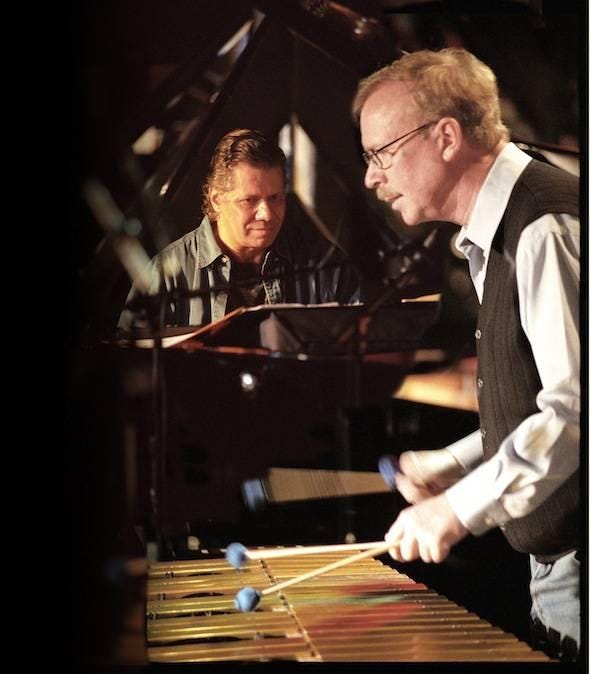
Corea and Burton each played at a Munich festival in 1972, but had never played together. They agreed to play together in a post-concert jam session where they received an enthusiastic response. They decided to record together later that year which led to their record Crystal Silence, released by ECM in 1973. Over their 40-year collaboration, Corea and Burton developed a sophisticated musical relationship with intertwined melodies, counterpoint, transparent harmony and improvisation that sounded composed even while it was being created. (BR Klassik). This Burghausen concert piece shows two incredibly accomplished musicians sounding spontaneous and relaxed because their underlying communication system had already been deeply established.
By the way, Burton’s four-mallet vibraphone method was central to accompanying Corea. Xylophone and marimba musicians had used four mallets before him, but Burton developed the specific four-mallet method known as the “Burton grip.” He worked it out while still in high school because he wanted to keep all four mallets in his hands while moving easily between single-note improvisation and four-note chords. This became the basis of his more pianistic approach to the vibraphone (Berklee College of Music.)
The full Burghausen Concert recording
Full Concert on YouTube
Key pieces:
02:16 Love Castle Corea’s Spanish-influenced harmonic language and Burton’s ability to turn complex lines into clear melody.
28:50 Chega de Saudade A Jobim composition opened up through reharmonization, rhythmic displacement and changing lead roles.
40:19 Time Remembered The quieter side of the duo: sustained harmony, restrained dynamics and Bill Evans–like lyricism.
49:00 Mozart Goes Dancing Corea’s mixture of classical counterpoint, rhythmic play and jazz improvisation.
1:05:06 La Fiesta Their strongest example of interactive phrasing: themes are passed back and forth, altered and recombined.
1:23:59 Armando’s Rhumba The playful encore in which they begin by sharing the vibraphone before Corea returns to piano.
The complete program was “Love Castle,” “Alegria,” “Can’t We Be Friends,” “Chega de Saudade,” “Time Remembered,” “Mozart Goes Dancing,” “Eleanor Rigby,” “La Fiesta,” “Blue Monk” and “Armando’s Rhumba.” (Sheet Music Library (PDF))
***