
Planet-Wide Bottlenecks
The points where human demand, machine demand, infrastructure, resources, and institutions begin to press against each other.

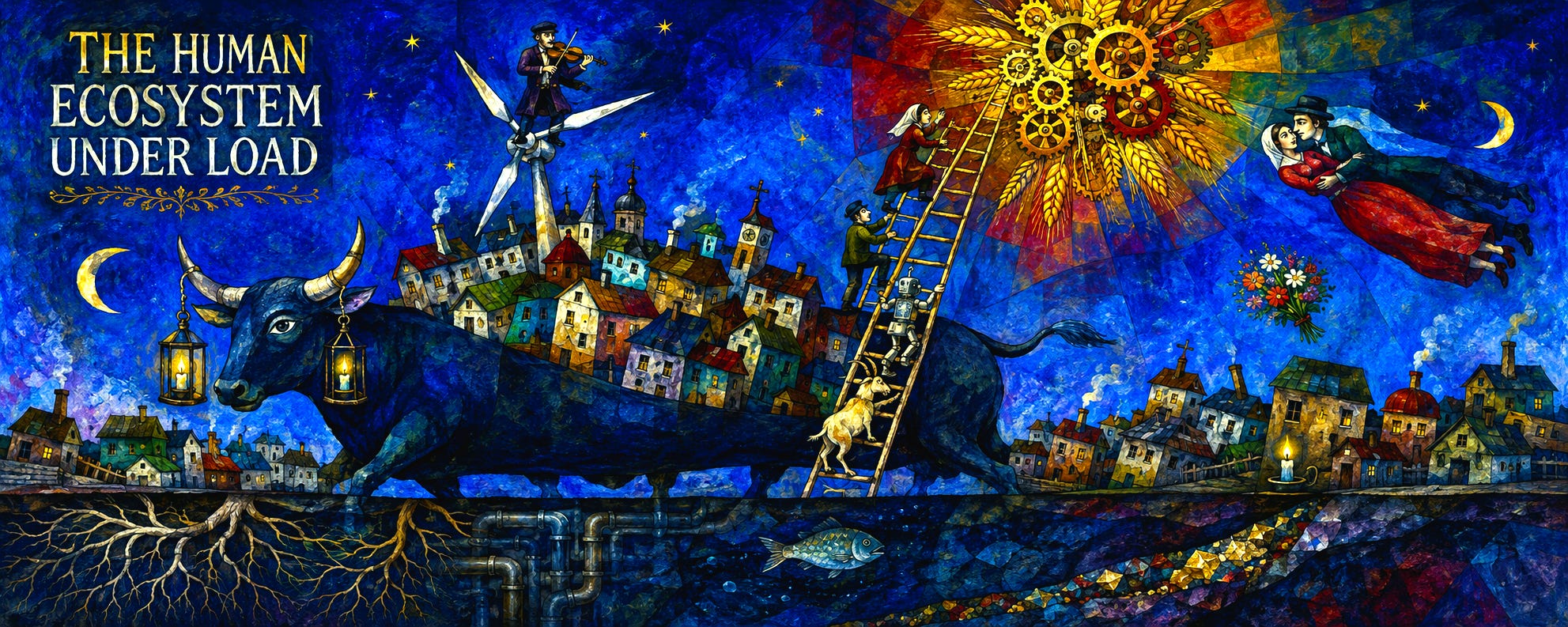
I do not mean this as a simple “we are running out of everything” argument. That is too crude. The more useful question is different: where does the system bind first?
That question came back to me while watching Elon Musk’s February interview about AI, energy, chips, rockets, and space-based data centers. Strip away the style, the bravado, and the improbable timelines, and one serious point remains: AI is becoming a hardware problem.
Not just a software problem. Not just a model problem. Not just a talent problem.
A hardware problem.
Musk’s immediate bottleneck is electricity. In the interview, he argues that chip production is rising much faster than electricity supply, especially outside China. His blunt formulation is that “the availability of energy is the issue.” The problem is not only whether we can design better AI systems. It is whether we can power them, cool them, connect them, finance them, and build the physical systems around them. That is the part I find interesting.
Most AI discussion still floats in software space: models, prompts, agents, copilots, copyright, jobs, regulation. All of that matters. But behind the screen is a much heavier stack: power plants, turbines, transformers, substations, transmission lines, water systems, semiconductor fabs, memory supply, cooling equipment, land, permits, financing, and political consent. And that is where the systems view becomes useful.
By a systems view, I mean looking not only at one variable, but at the feedback loops among many variables: demand, supply, price, infrastructure, regulation, capital, social resistance, substitution, and delay. A system is not just a collection of parts. It is the behavior created by the interaction of those parts over time. So when I hear “AI needs more energy,” I do not hear one sentence. I hear a chain:
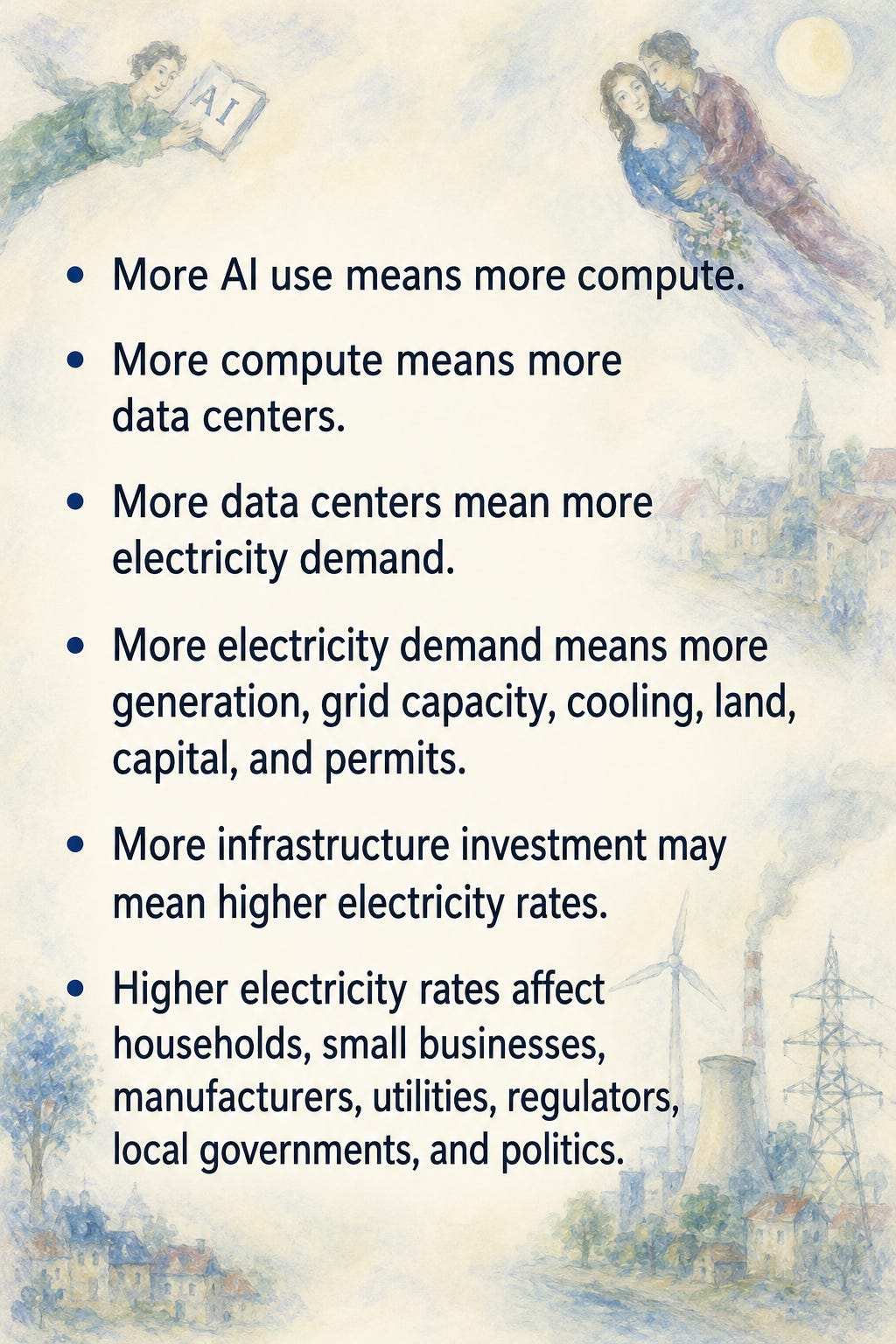
That is the system.
The Bottleneck Moves
The useful word here is bottleneck, not shortage. A shortage sounds like one missing thing. A bottleneck is more dynamic. It is the point in the system that currently limits throughput. Fix it, and the system does not become unlimited. It reveals the next constraint.
If electricity is solved, chips may become the bottleneck.
If chips are solved, memory may become the bottleneck.
If memory is solved, cooling, water, grid interconnection, rare-earth processing, transformers, skilled labor, or permitting may become the bottleneck.
The constraint moves.
This is one reason Musk’s interview is somewhat useful. Whether or not his space-based data center vision happens on his timetable is not the main point for me. What matters is the structure of the argument. He keeps forcing the discussion back to the physical stack: power generation, turbines, transformers, cooling, solar production, chips, memory, launch capacity, refining, and labor. In other words, he brings AI back into the world of atoms.
Malthus, Carefully

This brings me, carefully, to Malthus.
Thomas Malthus argued in the late eighteenth century that population tends to grow faster than food supply. In the simplest version, his model was population pressing against subsistence: more people, more food demand, more stress, and eventually famine, disease, war, or restraint.
I want to be clear before using Malthus as a reference point. I am aware that Malthusian ideas were later used in ugly and destructive ways: eugenics, colonial policy, coercive population control, and arguments that treated some human lives as burdens rather than lives. I strongly disavow that use of the argument. That is not my frame, and it is not the moral direction of this series. The reason to bring up Malthus is not to revive that politics. It is to recover the systems question underneath:
What happens when growth runs into limits?
Malthus was wrong in many direct predictions. Agricultural productivity rose. Technology changed. Trade expanded. Fertility fell in many societies. Human beings adapted. The food supply did not remain fixed in the way his model implied. But the underlying question did not disappear. It changed form.
Today the question is not only whether food can keep up with population. It is Whether energy systems can keep up with electrification and AI. Whether mineral processing can keep up with batteries, motors, chips, and defense systems. Whether water systems can keep up with cities, agriculture, industry, and cooling. Whether climate sinks can absorb the waste products of growth. Whether political institutions can permit and finance infrastructure quickly enough without losing legitimacy. That is the modern bottleneck problem.
Abundant in Theory, Constrained in Practice
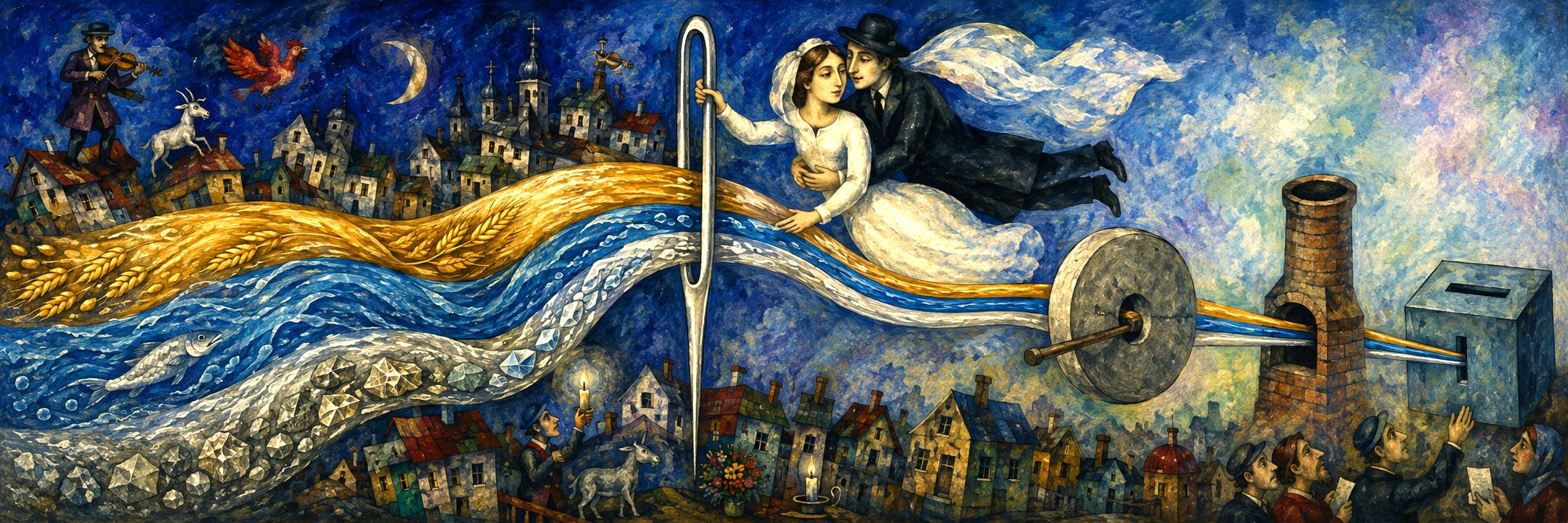
It is tempting to say: Earth has enough.
In some abstract sense, that may be true. The sun sends enormous energy. Many minerals are not geologically rare. Human beings are inventive. Markets adapt. Engineers solve problems. Institutions can change. But the system is not frictionless.
A resource can be abundant in theory and unavailable in practice. Solar energy is abundant, but solar farms need land, interconnection, transmission, storage, permits, capital, and public acceptance. Rare earths are not especially rare in the crust, but rare-earth processing is concentrated in specific countries and facilities. Chips do not appear because demand exists. They require fabs, lithography equipment, chemicals, water, power, yield curves, packaging, and memory.
Electricity is also not just electricity. It is electricity at the right voltage, in the right location, at the right time, with sufficient reliability. That distinction matters. The practical constraint is often not the resource itself. It is the production-and-delivery system around the resource.
Who Gets the Power?
Suppose AI companies can raise the money to build massive new data centers. Suppose investors are eager because expected profits are large. Suppose utilities and private developers respond by building generation, transmission, substations, and dedicated power facilities.

On paper, that looks like adaptation: Demand appears. Capital responds. Supply expands.
But then the real system questions begin:
Who pays for the grid upgrades?
Are the costs charged directly to the AI companies, or spread across ordinary ratepayers?
Do household electricity bills rise?
Do small businesses pay more?
Does manufacturing become less competitive?
Do local communities receive tax revenue, or mostly land conversion, water stress, and heat?
Does the new power come from gas, solar, nuclear, geothermal, hydro, batteries, or some mix?
Do regulators approve projects quickly, or does public resistance grow?
Do data centers get priority over housing, factories, farms, or electrified transportation?
These are not side issues. They are the system consequences. The energy bottleneck is not only technical. It is distributive. The grid is a physical network, but it is also a social allocation mechanism. It decides, through markets and regulation, who gets power, at what price, and with what reliability. That is why electricity rates matter.
A rate increase is not just a number on a bill. It is a transfer of pressure through the human ecosystem. Higher electricity rates can push a poor household closer to hardship. They can make a factory less competitive. They can improve the revenue base of a utility. They can accelerate rooftop solar for wealthier households. They can trigger political backlash against data centers. They can shift industrial activity from one region to another. That is how a technical bottleneck becomes a political bottleneck.
The Better Question
The old resource question was often framed as exhaustion: when do we run out? The newer question is about throughput: how fast can we responsibly move energy, materials, information, capital, and institutional decisions through the system?
And the harder question is about legitimacy: who benefits, who pays, who bears the side effects, and who gets a say?
This is why the optimism-versus-pessimism divide is not very helpful: The optimist says technology will solve it. That is partly true. Technology has solved many constraints before. The pessimist says limits will stop us. That is also partly true. Limits do not disappear because we dislike them.
The systems answer is less dramatic but more useful: technology changes the constraint; it does not abolish constraint. A solved bottleneck reveals another bottleneck. Growth continues, but the pressure moves.
If AI becomes a major new source of electricity demand, the consequences will not stay inside the AI industry. They will move through the electric grid into household budgets, industrial policy, land-use fights, climate strategy, water politics, utility regulation, capital markets, and geopolitics. That is why this series begins with bottlenecks rather than apocalypse.
I do not think the right question is whether humanity is doomed by finite resources. I also do not think the right question is whether innovation will magically remove every limit. The better question is this:
Can human systems adapt fast enough, fairly enough, and intelligently enough to prevent growth from turning into conflict?
Energy is the first place to look because energy sits underneath almost everything else: computation, manufacturing, logistics, food, water, cities, and now the expanding machine layer of the economy. But energy is only the beginning.
Once we look at the world this way, we start to see bottlenecks everywhere: chips, memory, copper, rare-earth processing, lithium refining, skilled trades, transmission corridors, cooling water, public trust, and political patience. The planet may not be “running out” in the crude sense. But the human ecosystem is under load.
The first step is to stop asking only how much resource exists. The better question is: where does the system bind, who feels it first, and what happens next?
Further Reading:
Elon Musk interview with Dwarkesh Patel and John Collison — the source for the “AI becomes a hardware problem” framing: electricity, chips, memory, turbines, transformers, and space-based data centers.
IEA — Energy and AI — the best quantitative anchor for data-center electricity demand, cooling, servers, networking, and the 2024–2030 demand outlook. The IEA estimates data centers used about 415 TWh in 2024 and projects about 945 TWh by 2030 in its base case.
Thomas Malthus — An Essay on the Principle of Population [1798] — the primary source for Malthus’s original population/resource argument. Useful to cite directly rather than rely on caricature.
Our World in Data — “Does population growth lead to hunger and famine?” — a useful counterweight to crude Malthusianism; it explains why famine and hunger cannot be reduced simply to population growth.
AP summary of the 2023 planetary boundaries study — a readable source for the broader “planetary systems under load” framing: climate, biodiversity, freshwater, land, nutrient flows, and novel chemicals.
***