
Know Your Neighbors
Why studying abroad is infrastructure, not a vacation.

This is the eighth post in a series on globalization, and the through-line has been simple. Nothing important gets built by one country alone. A Short History of Human Interdependence traced how far back that dependence runs. The Economics of Why explained why two countries both come out richer from trade even when one is better at everything. Things No Country Builds Alone showed the same logic in physical form. Old World, Rising World looked at who is gaining and who is slipping.
Collaboration is not a feature of globalization. It is the thing itself, and on balance it has left almost everyone on the planet better off. This post adds the piece the earlier ones assumed: the people. Cross-border cooperation runs on individuals who actually understand the other side, and that understanding is rarer than it looks.
The blank and the wrong picture
Ask people in wealthy countries what share of the world lives in extreme poverty. Most say it is rising, or holding steady. It has halved in twenty years. On a set of basic questions about poverty, health, and population, only about 7 percent got the poverty question right. A chimpanzee picking answers at random would beat them.
Hans Rosling spent years documenting this. His point was not that people know nothing. It is that they confidently know things that are wrong, which is a harder problem to fix. For instance, most of the generic medicine in an American or European cabinet is made in India, and the Indian plants that make it depend on China for roughly 70 percent of the chemical ingredients.
Ignorance used to be a blank: the country you had never heard of. Now it is more often a blind spot: the country you depend on every day and never picture. A blank invites a question. A blind spot does not.

The tendency is structural, not a character flaw. Large, self-sufficient countries feel less need to understand others, so they learn less about them. A small trading country learns the world because its livelihood depends on it. In the US, college enrollment in languages other than English fell about 17 percent in five years, the steepest drop on record. But this is a pattern of big powers in general, not one nation. The bigger and more self-contained you are, the easier the rest of the world is to ignore.
The tendency is structural. Large, self-sufficient countries feel less of a need to understand others, so they learn less about them. A small trading country learns the world because its livelihood depends on it. In the US, college enrollment in languages other than English fell about 17 percent in five years, the steepest drop on record. But this is a pattern of big powers in general, not one nation. The bigger and more self-contained you are, the easier the rest of the world is to ignore.
The claim
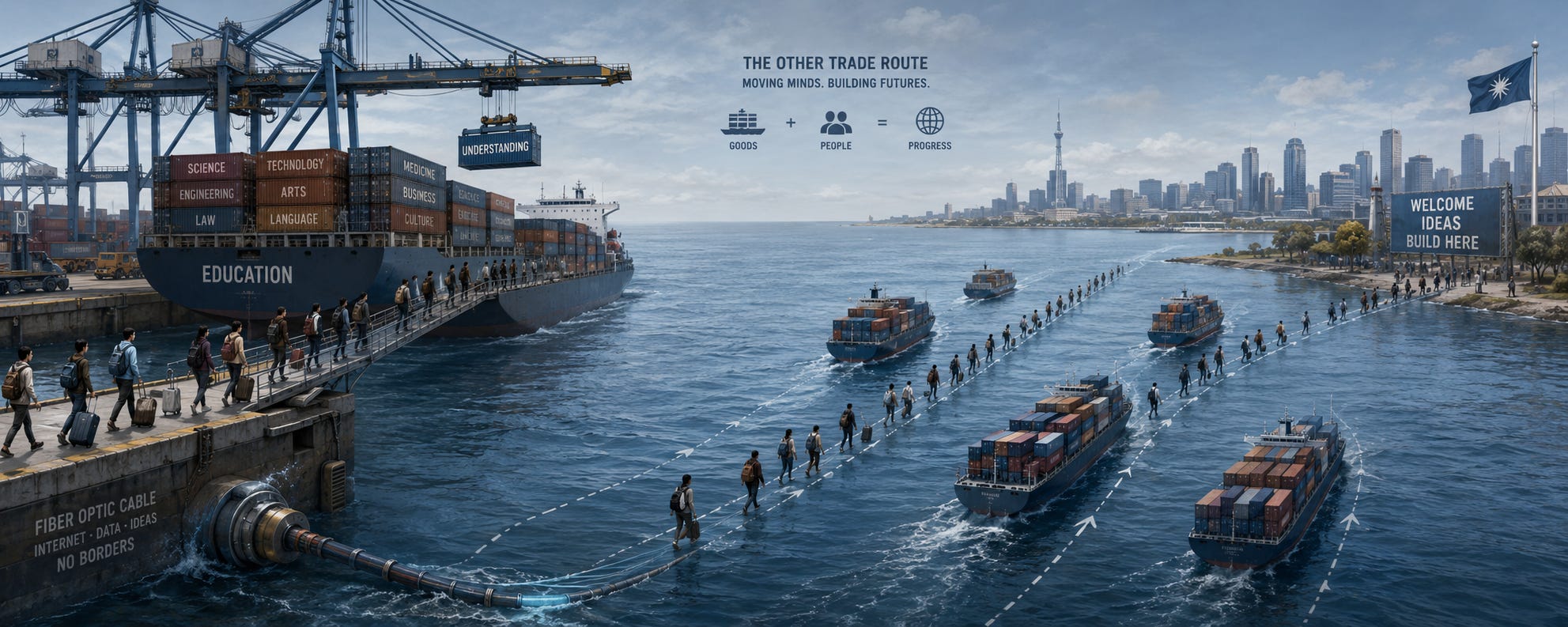
Student mobility is infrastructure for globalization, as real a port or an undersea cable. It is one of the few channels through which the soft inputs of good cross-border decisions travel. Direct exposure is how a person turns a low-resolution model of the world into a working one, and you cannot reason well about a system you have only seen from inside one country.
Five things you only see from the other side
My daughter spent two years in Taiwan. She did not come back with takes about Taiwan. She came back knowing it the way you only can from living somewhere: not as a step in a supply chain or a headline about tension in the strait, but as a place full of people going about their day.
Five things you only see from the other side:
You cannot design a product, a service, or a development project for a market you have never stood in. Needs that look obvious from headquarters dissolve on contact with the actual customer.
You cannot read capacity from a slide deck. Telling a real institution from a polished one takes having seen the real thing up close.
Innovation is recombination, and recombination needs people who have lived on both sides of a border to carry the pieces across.
Cross-border finance runs on trust, and a surprising share of that trust begins as classmates who later pick up the phone.
And a deal is only win-win if you can see the other side’s win clearly. As the last post argued, you cannot see it from home.
Outward learning is a choice
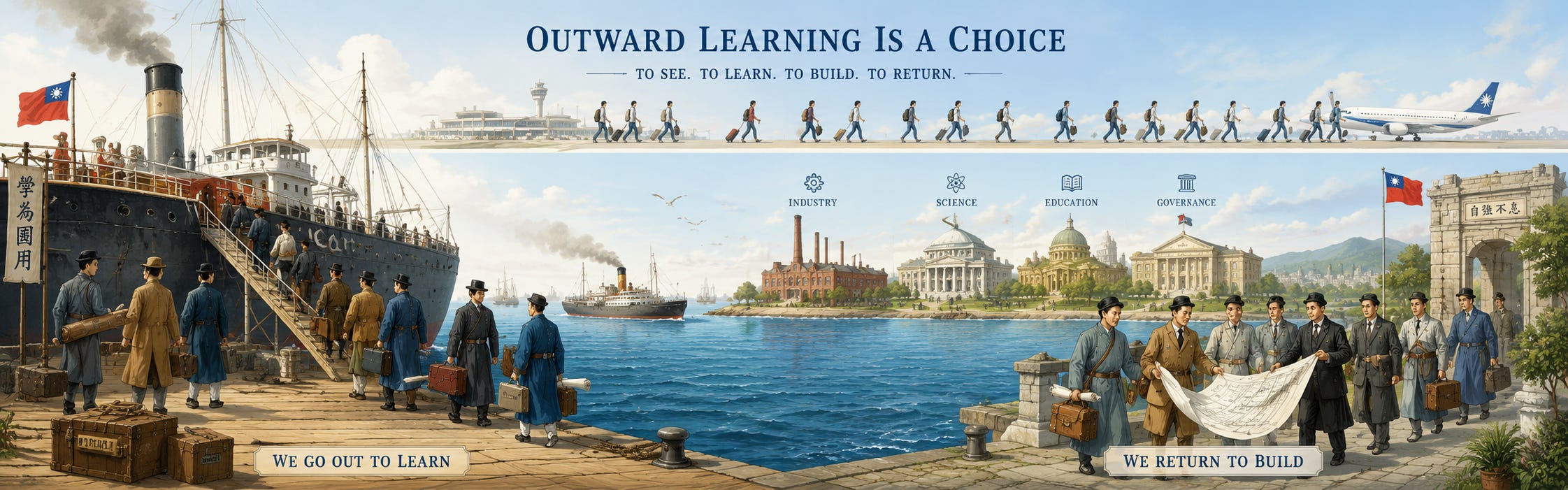
In 1871, Japan sent its senior leadership abroad. The Iwakura Mission spent almost two years touring American and European factories, schools, and parliaments, then came home and rebuilt the country around what it had seen. A rising power treated outward learning as national infrastructure.
China has done a version of this at enormous scale. Between 1978 and 2024, roughly 8.9 million Chinese went abroad to study, and about 6.4 million have returned, lately at close to nine in ten. The lesson is not to copy China or Japan. It is that outward learning is a thing a country designs or neglects. Incumbents tend to forget they ever needed it.
The picture on the screen
A student arriving in America has already watched it for years in movies, television, and endless feeds. The pictures are vivid, confident, and often wrong, and the danger is precisely that they feel well-informed. More hours of content can actually lower the accuracy of one’s model while raising your confidence in it. George Gerbner called the slow shaping of belief by heavy viewing “cultivation”. Spending time in the place is the only reliable correction, because it forces the picture to collide with the real thing. The arriving student meets the America of rent, paperwork, weather, and ordinary unglamorous Tuesdays, where real friendships take months rather than minutes.
The honest counterpoint
Two objections, both fair: The first is elitism: studying or living abroad is mostly available to people who are already advantaged, so calling it infrastructure can dress a privilege up as a public good. The second is that it does not reliably work. You can spend a year abroad inside an expat bubble and come home with every assumption intact, now with a stamp on it.
The answer is not to deny either one. It is that who gets to move, and whether the time abroad is genuine immersion or a sealed bubble, are choices. Broad access and real contact do not just happen. They grow out of how a society raises its people: an education that points outward, a culture that rewards curiosity, a home that treats the wider world as worth knowing.
What comes next
This post has quietly stopped being about maps. The next ones stay with the mind rather than the map: the habits of reasoning, critical, systemic, and probabilistic, that let a citizen think clearly about a connected world. Knowing your neighbors is where it starts. Thinking clearly about them is the rest of the series.

***
Not sure where you're going with this so this may be a moot point, but:
Poverty is not just absolute poverty; it is also about relative poverty. It's my understanding that once minimal basic needs are covered, in fact, relative poverty is psychologically far more jarring than the poverty alone. Also of great concern is the size of the middle class and the mobility of people to change status: to fall in and out of it.
It's my understanding that all of these measures are going in the wrong direction: the rich are getting a lot richer while the poor are getting just a little less poor; the middle class is shrinking; and wealth mobility is almost nonexistent. However, I have to admit that this morning I'm too busy to run down that rabbit hole to check. ;-)