
AI, Three Years In
Or: what we actually mean when we say “AI” in 2026.

In November 2022, ChatGPT reached one hundred million users in two months, faster than any product in history. Today, that chatbot is the simplest thing AI does.
When most people picture AI, they picture a chat window: type a question, read the answer. That picture is already two generations out of date. AI in 2026 is at least four things at once, each one moving at its own speed.
To make sense of AI’s impact on your work and life, it helps to see the four layers separately. They evolve on different clocks. They affect different jobs. And they ask different things of you.
Post 2 of a series on AI for everyone.
From pattern recognition to neural networks
The core idea is almost a hundred years old. In 1943, two researchers proposed a brain neuron model that looks like a simple switch: signals come in, get weighted, fire if they pass a threshold. String enough switches together and you have a network that can learn from examples (your memory) instead of from rules.
For decades it didn’t really work. Networks were too small, data was too thin, computers were too slow. “Neural networks” sat in a quiet corner of academic research from the 1950s into the 2010s.
Then three things converged: enough data (the open internet), enough compute (graphics chips built for video games), and a clever new architecture called the transformer (2017). By late 2022, the pattern recognizer had finally caught up to the idea, and the public noticed.
Language models, in one picture
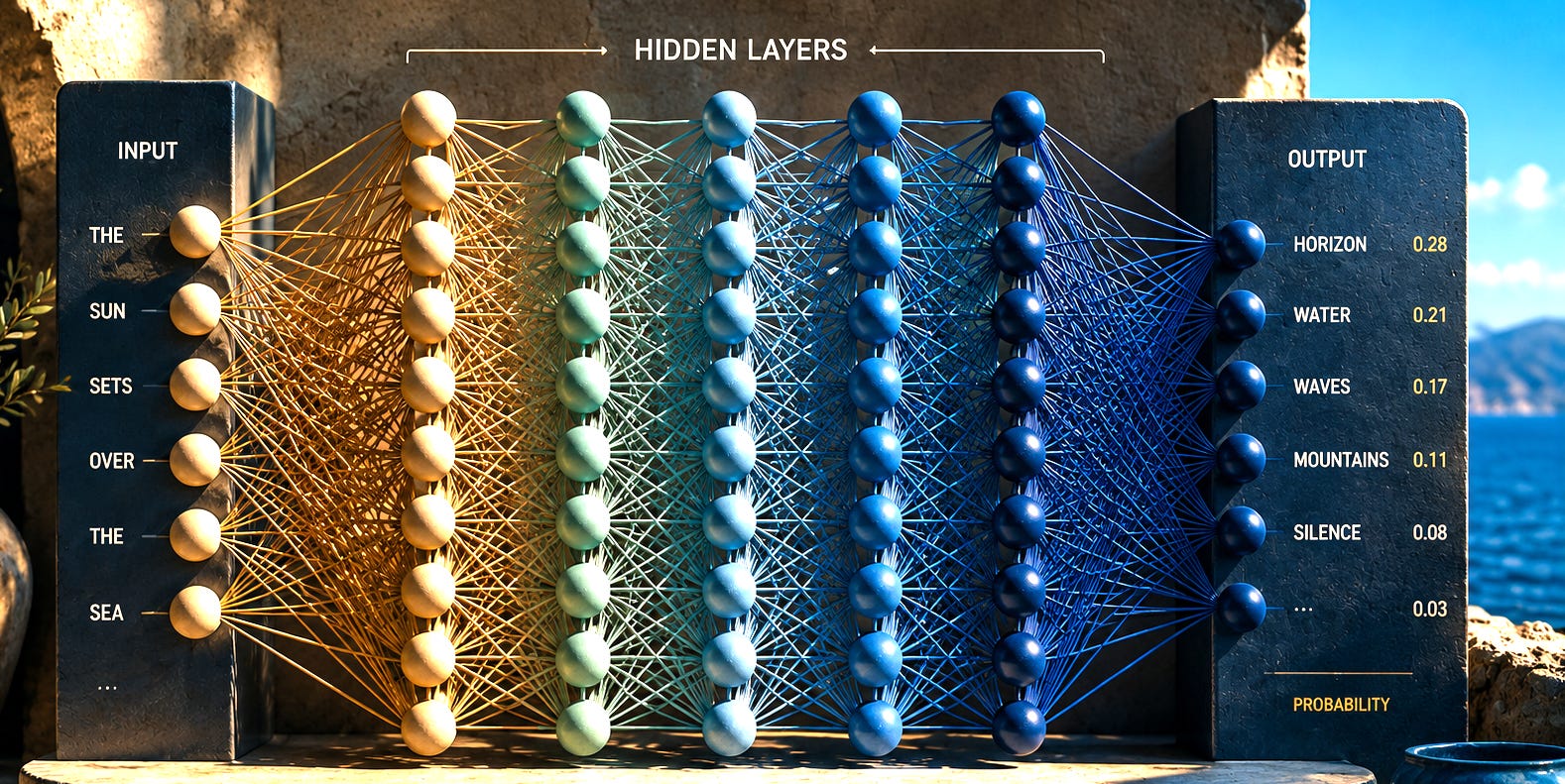
Here is roughly what happens when you type into ChatGPT or Claude.
I will be glad to send you higher resolution of the three figures in this post.
Please subscribe and I will email them to you. Just reference the publication thecriticalpost.substack.com if you use them.
The model takes a string of words on the left, runs them through layers of weighted connections, and produces probabilities on the right: horizon 0.28, water 0.21, waves 0.17, and so on. It picks one. Then it does the whole thing again, with the new word added to the input. Then again.
That is the trick. A language model is a very expensive next-word guesser, trained on enough text that its guesses carry meaning, grammar, style, and a remarkable amount of the world’s knowledge in compressed form.
It does not “know” things the way you do. It has learned, from patterns across billions of pages of human writing, what the next word probably is. Most of the time that is enough. Sometimes it is not. We will come back to that.
Agentic AI: from answer to action
A chatbot is bounded by its window. An agent is not.
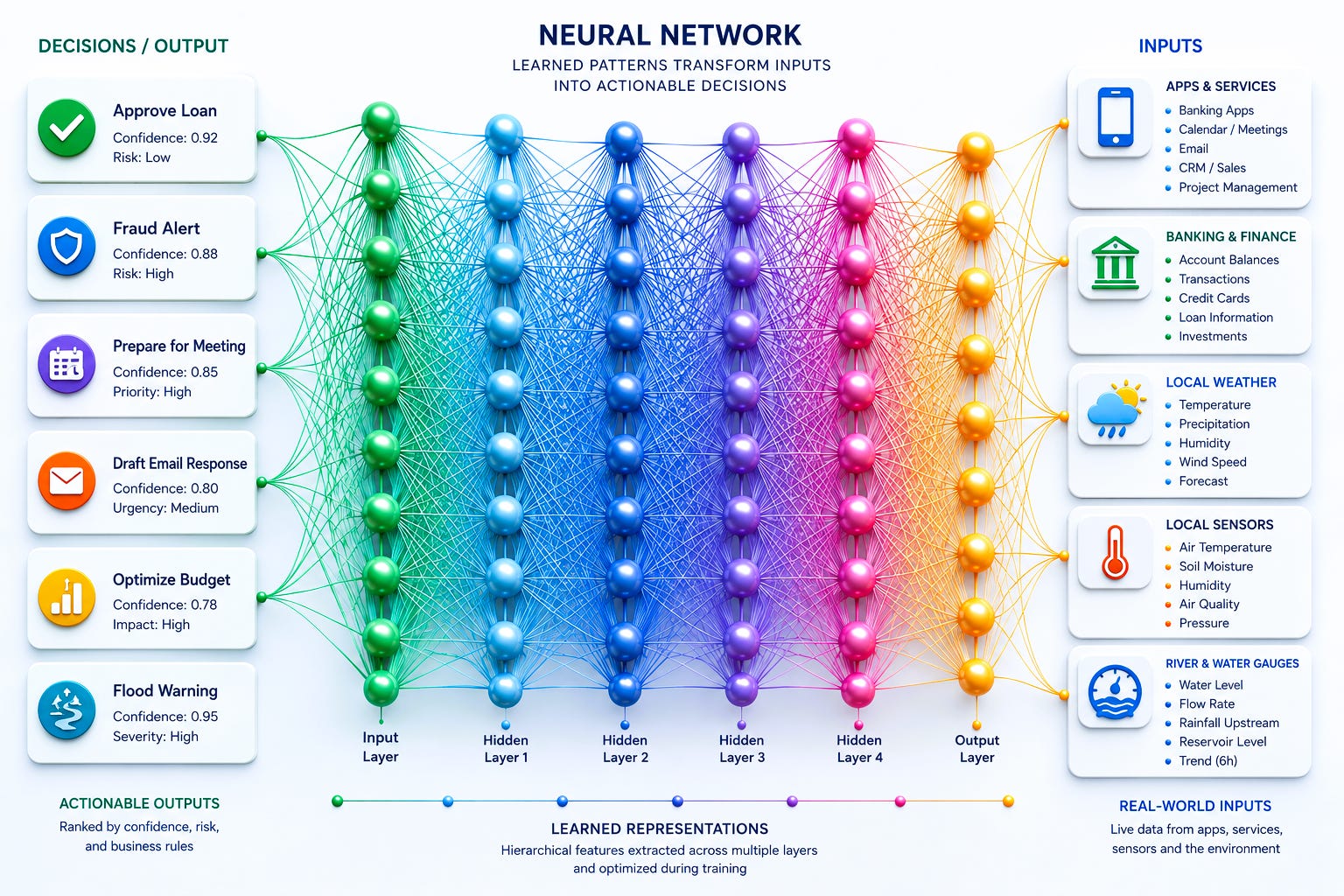
Agentic AI reaches out. It reads your calendar, queries your bank, checks the weather, pulls a reading off a river gauge. Then it does things: books the meeting, flags the suspicious transaction, drafts the reply, sends the flood warning.
The shift from chatbot to agent is the shift from advisor to participant. The model is no longer waiting to be asked. It is acting on your behalf, inside your systems, often without you watching each step. That is powerful and uncomfortable in roughly equal measure.
AI coding: describe, don’t type
Of the four faces, this is the one already reshaping jobs.
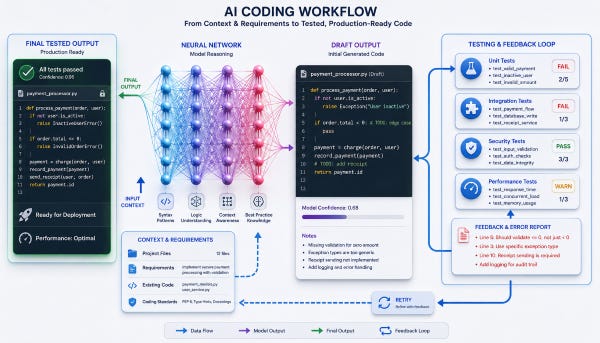
A developer used to write every line of code in whatever computer language was specified. Now they describe, in plain English, what they want a program to do, and the model produces the code. The developer reads it, runs it, asks for changes. The work has moved up a level, from typing to specifying.
This is the fastest measurable impact of AI on white-collar work today, and it deserves its own post. The short version: routine coding tasks are now largely automated, and experienced engineers are getting a productivity multiplier no profession has seen in a generation.
Validation: the hidden engine
Look at the same figure once more. The interesting part is not the neural network in the middle. It is the loop on the right.
The model produces draft code. A test suite runs against it. Failures come back as a feedback report. The model tries again. Only when the tests pass does the output leave the system.
That same idea (draft, test, retry, ship) is starting to show up well beyond coding. It is the practical answer to the “AI hallucinates” objection, and it will be the subject of a later post.
The honest counterpoint
Some readers will say this sounds too clean. Recent industry surveys have found that most enterprise AI pilots never reach production. Agents get stuck. Coders produce subtly broken programs. Validators miss the same errors the model made. The gap between a slick demo and a deployed system is still very wide.
Fair. The point of this post is not that the four faces are finished products. It is that they are real, distinct categories, evolving on different clocks, and you will meet all four in the next year whether you signed up for it or not.
Questions for you
Which of the four faces have you actually used in the last month?
Where in your work would an agent be useful, and where would it be dangerous?
If a junior colleague in your field is suddenly five times more productive, what changes about how you hire and how you train?
Next week
Post 3 will dig into the language-model layer: why next-word prediction produces such strange competence, and why the same mechanism produces hallucinations.
Further reading
Attention Is All You Need (Vaswani et al., 2017): the transformer paper that started the current wave.
Gary Marcus, The Next Decade in AI: a skeptical view of where current methods are headed.
A short Anthropic or OpenAI explainer on agentic systems: the supply-side perspective on what agents can and can’t yet do.
***