
AI: After the Prompt...
How loops turn capable AI into practical work


This is the first of a three-post series on AI as an operating system rather than only a conversational tool. This post explains loops and the six elements that make them useful. The next posts will examine digital twins—connected representations that can test strategy, demand, operations, regulation, financing, risk, and implementation against one another.
In AI: Notes From the Beginning of an Odyssey, I described watching Claude work: opening files, checking facts, correcting itself, and continuing. What struck me was not only the output. It was the process. That post ended with scheduled tasks running on my behalf. This one asks what AI can continue doing after the first answer.
From chat to task to loop
The public experience of generative AI began with chat: You asked a question. The model answered. You judged the answer and decided what to ask next. The human carried the objective, context, and sequence.
Then came the task. AI could examine files, conduct research, compare alternatives, prepare a draft, and save the result. But the task still began with one human instruction.
Now comes the loop. Boris Cherny, the creator and head of Claude Code at Anthropic, recently described the change this way: “It’s an agent that prompts Claude. I don’t write the prompt anymore. Claude writes the prompt, and now I’m talking to that new Claude.”
Cherny was speaking about software, where AI can write code, test it, inspect the failure, revise it, and test again. But the principle is broader: A loop gives AI an objective, lets it take a step, examines the result, and decides what should happen next. It continues until the work is complete, a limit is reached, or human judgment is required.
A chat produces an answer. A task produces a deliverable. A loop manages a continuing process.
This is a logical step. A useful assistant should not need a new instruction after every movement. It is also important because it changes where practical value comes from.
Beyond model training
Most AI discussion still concentrates on the model: more data, more compute, stronger reasoning, better scores. Those advances matter. But organizations receive value when intelligence is connected to an objective, current information, useful tools, quality controls, and decision rules.
A brilliant employee with no job description, no access to the files, no authority to act, and no understanding of when the work is finished will not be productive. The same is true of AI.
The models are improving. The systems around them are learning how to put that capability to work.
A useful loop has six elements.
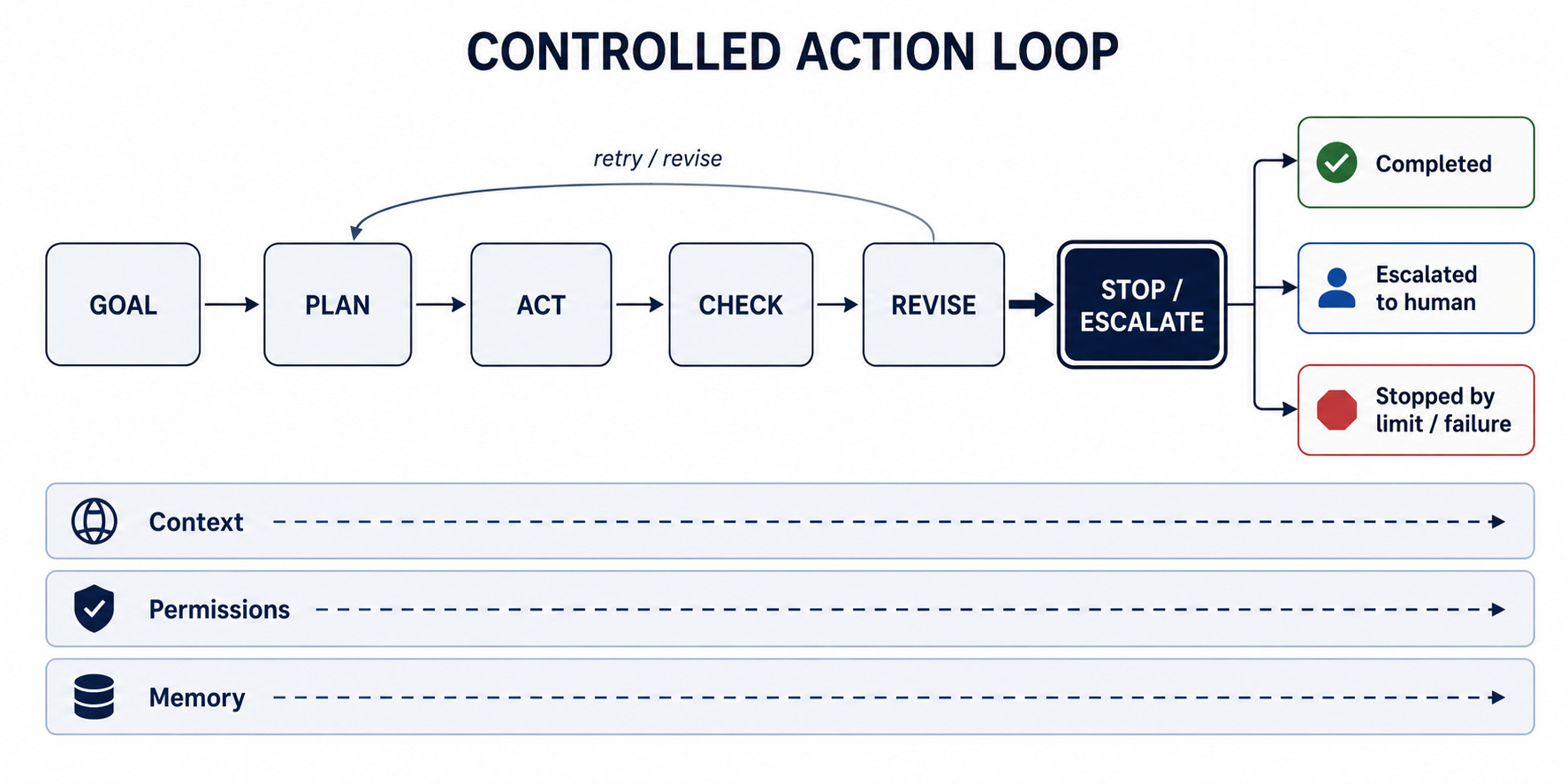
1. Objective: what result is the loop pursuing?
The objective defines an outcome, not merely an activity. “Read the news” is an activity. “Produce a weekly report identifying developments that could materially affect our market” is an objective.
The second version lets AI judge whether an item matters, whether more research is needed, and whether the report is complete. It converts general capability into directed work. Without an objective, a loop can remain busy without becoming useful.
2. Working context: what does it need to know?
Practical work depends on what is true here, now, and inside a particular organization. A market loop may need the company’s products, competitors, priority countries, previous reports, approved sources, and definition of a material development. A proposal loop needs the solicitation, draft, attachments, criteria, and verified experience.
Context reduces polished but irrelevant answers. It also preserves continuity: what has been reviewed, concluded, and left unresolved. The model supplies broad capability. Context supplies the job.
3. Allowed actions: what may it do?
A loop may need to search, retrieve files, calculate, compare records, create a draft, update a spreadsheet, or place a result in the correct folder. The allowed actions define its reach. A customer-service loop might read an account history and issue a small credit. It should not close the account or approve a large refund without permission.
This moves AI from commentary toward participation. It also separates what the system can do from what it is authorized to do.
4. Test: how does it know whether the step worked?
This may be the dividing line between fluent AI and effective AI. A model can produce a convincing answer without knowing whether it is correct. A loop needs feedback from outside the answer.
Software can be tested. A proposal can be checked against every mandatory requirement. A market report can require corroboration. A revised schedule can be measured against the target date and available resources. The test gives AI something more useful than confidence: evidence. It allows the system to detect failure, revise, and try again.
5. Stopping criteria: when is enough enough?
A loop without stopping criteria can continue searching and revising after the additional value has disappeared. A market report may stop when every priority market has been reviewed and all high-impact claims have support. A proposal loop may stop when the requirements, attachments, and page limits are satisfied.
Stopping criteria also include failure conditions: stop after three unsuccessful attempts, when cost reaches a limit, or when required information cannot be found. The point is not to create a system that never stops. It is to create one that knows why it is still working.
6. Human escalation: when must it return control?
Some decisions are uncertain, consequential, political, ethical, or irreversible. A well-designed loop surfaces them. A complaint involving fraud should go to a person. A proposal ambiguity that changes contractual risk should go to management. A recovery plan requiring more funding should go to the budget owner.
Escalation is part of the design. AI handles repetitive collection, testing, comparison, and preparation. People retain authority over judgment and consequence. The goal is not maximum autonomy. It is an effective division of labor.
MCP: connecting the loop to the work

The six elements describe the management logic. The loop still needs connections.
In my earlier post, I described the Model Context Protocol, or MCP, as a standard plug that lets AI reach into applications such as Box.com (which my company uses). Anthropic introduced MCP in November 2024 as an open standard for connecting AI systems with data repositories, business tools, and development environments.
Without a common connection, every AI product needs a separate integration with every application. The model may be capable, but it remains isolated from the current file, project folder, database, or workflow. MCP does not make the model more intelligent. It makes the intelligence usable. The model, context, tools, and loop are beginning to form one working system.
Where this may lead
Imagine a company considering entry into a new market. One continuing AI process tracks demand, prices, customers, and competitors. Another follows capacity, costs, suppliers, and workforce constraints. Others track regulation, financing, schedules, and implementation risks.
Demand says the opportunity is attractive. Operations says capacity is insufficient. Finance says the full expansion would exceed the debt limit. Regulation identifies a licensing delay. Implementation tests whether a phased rollout could work. These AI loops exchange assumptions and run the scenario again.
Or consider a hospital expansion. Patient demand, staffing, beds, construction, reimbursement, regulation, and financing would each be represented by a continuing process. A change in one would alter the others. This is not one all-knowing AI making a decision. It is a set of connected, updating models helping people see whether a plan is internally consistent—and where it breaks.
The next posts will examine how digital twins may move beyond machines and facilities toward strategy, markets, organizations, and implementation. But the foundation is the loop.
Before AI can represent an enterprise, it must know how to pursue an objective, use the right context, take bounded actions, test the result, stop at the right point, and return judgment to a person.
The emerging skill is not simply writing a better prompt. It is designing a process in which AI can keep working without losing sight of the purpose.
Sources and further reading
AI: Notes From the Beginning of an Odyssey — The Critical Post
Building Effective Agents — Anthropic
Introducing the Model Context Protocol — Anthropic
Forget Prompt Engineering: “Loop Engineering” Is All the Rage Now — Business Insider
***